Google Research Moves Federated Learning Into TEEs: Gboard Now Trains With Externally Verifiable Differential Privacy
The Avocado Pit (TL;DR)
- 🥑 Google is supercharging Gboard with federated learning in TEEs for better privacy.
- 🔒 Your keystrokes are now safer thanks to externally verifiable differential privacy.
- 📜 Policies are public on Sigstore's Rekor log, making privacy checks a breeze.
Why It Matters
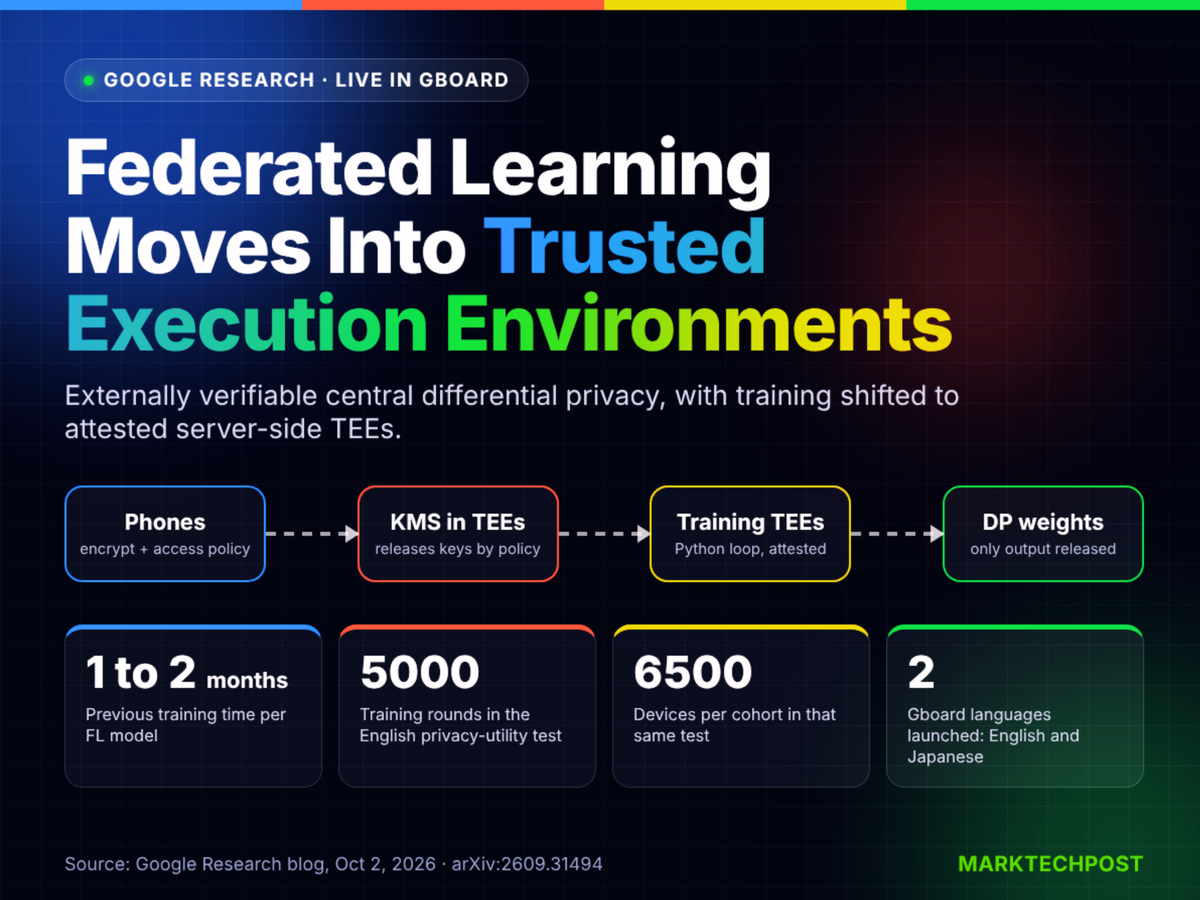
The next time you're typing out a message and Gboard suggests the perfect next word, know that it’s not just Google being psychic. They’ve taken a giant leap in privacy tech by relocating federated learning’s gradient computation from your phone to trusted server-side environments, known as TEEs. This isn't just a tech flex; it means your data is safer and more private than your awkward high school diary. 🎉
What This Means for You
In plain English: your personal data is now more secure when using Gboard, thanks to some clever cryptographic wizardry. Google’s latest move ensures that even while they’re improving AI suggestions, your private data remains private. Plus, with public access policies, any doubts about data privacy can be independently verified. So, text away with peace of mind!
The Source Code (Summary)
Google Research has rolled out an enhancement to their federated learning system, shifting gradient calculations to server-side TEEs (Trusted Execution Environments). This system leverages externally verifiable differential privacy, ensuring that the data used for training remains secure and private. By publishing access policies on Sigstore's Rekor log, the approach ensures transparency and verifiability. Currently, Gboard is utilizing this technology for English and Japanese next-word prediction, making your typing experience more intuitive without compromising your privacy.
Fresh Take
Alright, let’s break down the nerdy details: This is a big win for both privacy enthusiasts and anyone who has ever cringed at their own autocorrect fails. By using TEEs, Google ensures that sensitive data like your typing patterns doesn't just float around in the cyber-ether. It’s like having a bouncer for your data – only the cool, verifiable bits get in. This shift not only bolsters security but also sets a precedent for how tech giants can handle data responsibly. It's a promising step toward a future where privacy isn't just an afterthought but a priority. Now, if only they could make sure autocorrect never changes "ducking" again...
Read the full MarkTechPost article → Click here